
The quality of your concrete might not be something you question until cracks appear, walls weaken, or a structure fails far too soon. However, to avoid such misfortunes, critical testing of concrete mixtures is important.
At the Guyana National Bureau of Standards (GNBS), qualified Laboratory Technicians offer testing of concrete mixtures in the form of concrete cubes, to ensure the mixture produces strong, quality structures. Timely testing protects builders, homeowners, and the public by confirming that this essential building material can withstand the demands of time, weather, and other conditions.
As the construction sector continues to prosper, many contractors and homebuilders are opting to purchase ready-mixed concrete. Ready-mixed concrete, as defined by the National Standard “GYS 227 – Specification for Ready-Mixed Concrete,” is concrete delivered to the site or into the purchaser’s vehicle in a plastic condition, ready for placement without further treatment.
Recognising that buyers are not witnesses to the mixing stage of this product and may have doubts about its strength, the GNBS’ Industrial Metrology and Testing (IMT) Department offers testing to both suppliers and builders.
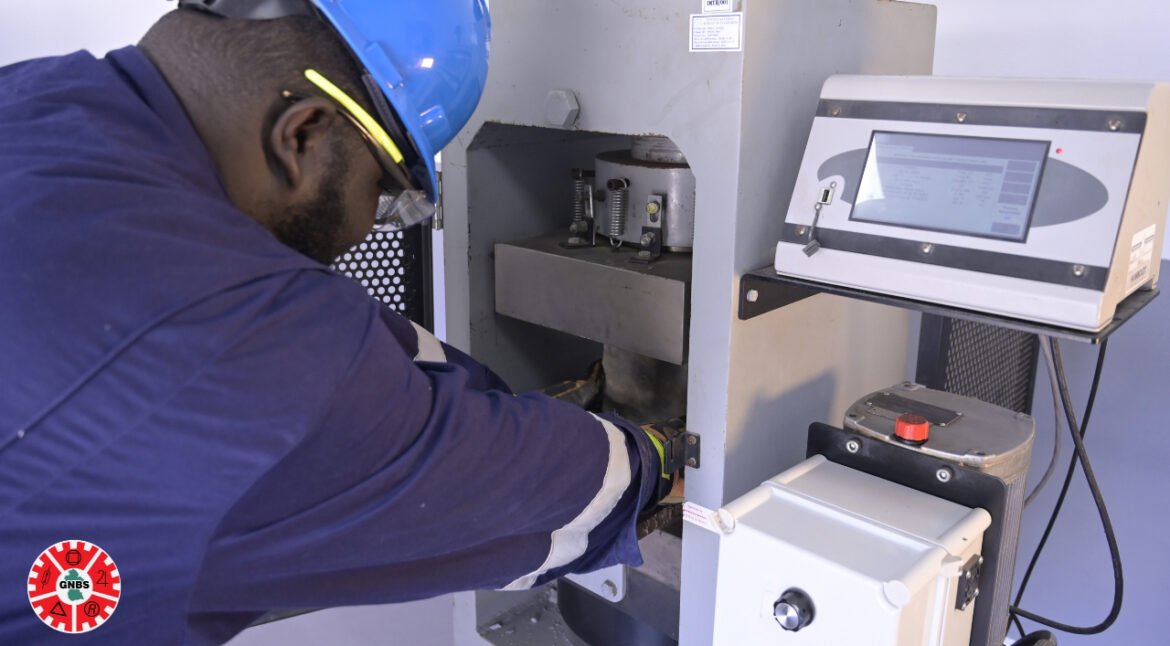
Interested clients are required to submit three cubes for testing to GNBS’ Georgetown location. These can be submitted after curing for 24 hours, seven days, 14 days, 21 days and 28 days. Once submitted to the GNBS, the cubes are measured and weighed before they are tested for compressive strength using a compression testing machine and a test certificate is provided at the end of the process.
These tests are offered in accordance with international standards. In this case, the standard used is the European Standard – “BS EN 12390-3 Testing hardened concrete – Compressive strength of test specimens.” The standard is part of the BS EN 12390 series, which specifies a method for determining the compressive strength of hardened concrete test specimens.
Contractors and homebuilders looking to test the strength of their structures which were already built can also do so, using the GNBS’ Non-Destructive Testing (NDT) service. This is done with the use of a Rebound/Schmidt Hammer to ascertain the quality of concrete floors, walls, posts, fences, bridges, etc. The equipment can also determine the compressive strength of concrete used to make concrete electrical poles, columns, foundations, etc. with a range from 0 – 8400 Pounds per Square Inch (PSI) or 0 – 58 Megapascals (MPa). Using the rebound method, this test provides a convenient and rapid indication of the compressive strength of the concrete structure. Once the strength of the concrete is determined, a certificate is prepared and provided by the GNBS to clients, and it can be used as a firm basis for the acceptance or rejection of a structure.
Further, the GNBS provides testing for concrete cylinders and concrete hollow blocks (size three, four or six inches). These services are available to small block makers and large manufacturers, homeowners and contractors, among others. This has resulted in several of these stakeholders becoming aware of the quality of the blocks they manufacture, and at the same time, increased the quality consciousness of consumers regarding this widely used building material.
Meanwhile, calibration is also provided for compression testing machines to promote accurate readings. This calibration exercise is done on the site. Interested clients can schedule this service through the GNBS website – https://gnbsgy.com/metrology/industrial-metrology/.
For further information on how to access this and other services, contact GNBS at 219-0064-66, via WhatsApp at 692-4627 or email info@gnbsgy.org